
Korea's Youth Savings Account (cheongyak [cheongnyeok] account, a policy savings product for young adults) and the ISA (Individual Savings Account, or gaeinjong jabsanonri gyeoa) are both called "tax-advantaged accounts," but the way they save on taxes and the level of government involvement are entirely different. As of 2026, more young adults are weighing the options of holding both products simultaneously or moving funds from one to the other — but reaching a conclusion of "which is better" without a specific condition-by-condition comparison is risky. The judgment framework below uses the core variables of mandatory holding period, government contribution, and tax-exemption structure as its axes.
Structural Differences Between the Two Products
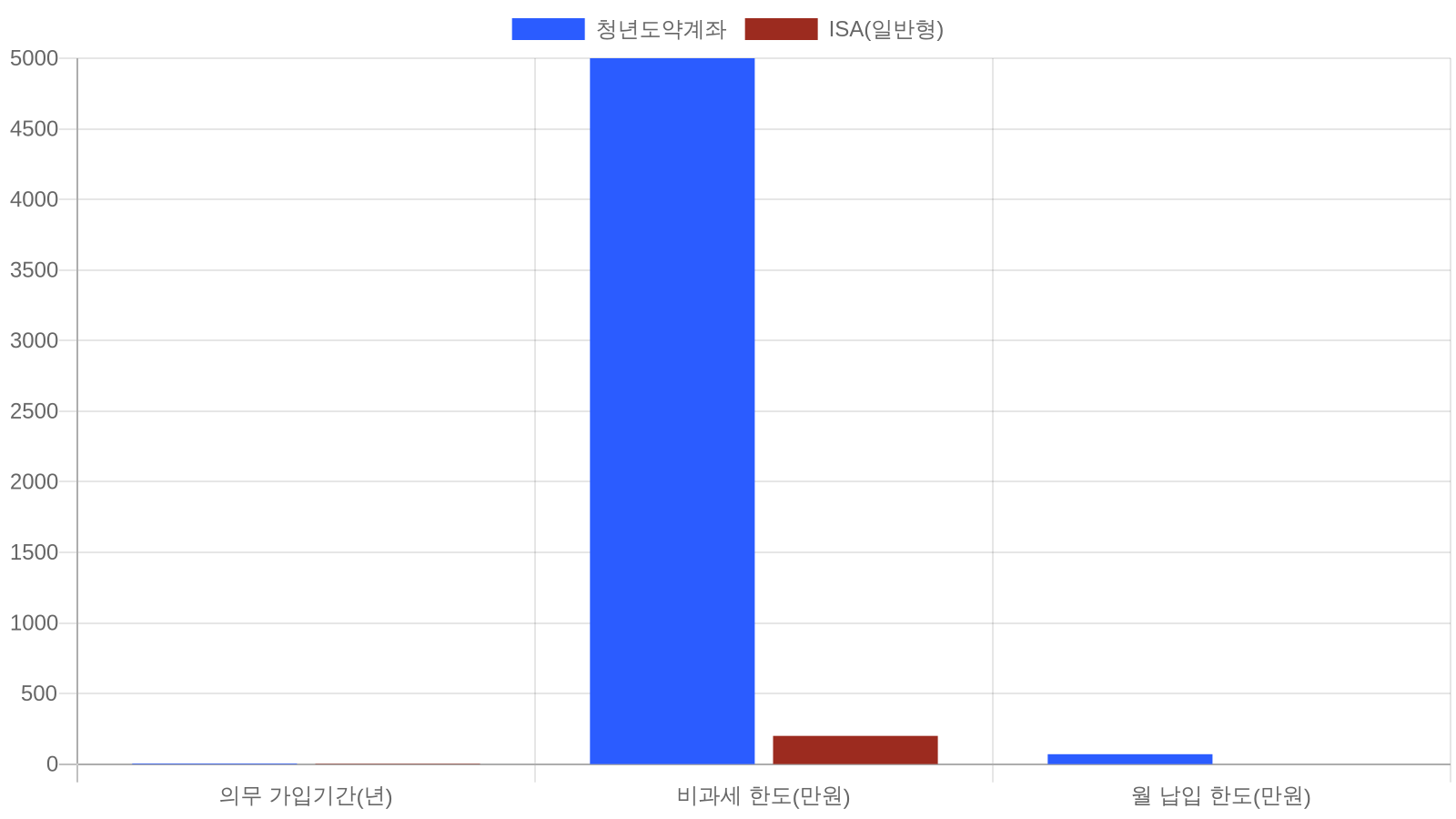
The Youth Savings Account (cheongnyeok gyeoa) is a policy-driven savings product for adults aged 19 to 34. Up to 700,000 won (approximately $510) per month can be deposited for five years, and the government contributes a maximum of 24,000 won per month depending on the account holder's income bracket. Interest income is tax-exempt at maturity, and the government contribution is the core "subsidy" element. The mandatory holding period is five years; if closed early, the government contribution must be returned.
The ISA (Individual Savings Account) is a comprehensive tax-advantaged account open to domestic residents regardless of income. It can hold a variety of financial products — deposits, funds, ETFs, REITs, and more — all in a single account, with a mandatory holding period of three years. The tax-exempt cap is 2,000,000 won (approximately $1,450) for the standard type and 4,000,000 won for the low-income/agricultural worker type, with gains above the cap subject to a 9.9% separated tax. There is no monthly contribution limit; the annual cap is 20,000,000 won (lifetime limit of 100,000,000 won).
The biggest structural difference between the two products is the presence or absence of a government contribution and the range of investable assets. The Youth Savings Account has a simple structure in which a bank deposit rate is supplemented by government contributions, while the ISA lets account holders determine their own asset allocation. If you are willing to accept return volatility in pursuit of market returns, the ISA's flexibility is advantageous; if you want principal protection and a fixed return, the Youth Account's contribution structure can enhance the effective yield.
Condition Comparison by Key Numbers

| Item | Youth Savings Account | ISA (Standard) | ISA (Low-income / Agricultural) |
|---|---|---|---|
| Eligibility | Ages 19–34; income requirement | Domestic resident (no income requirement) | Total annual salary 50,000,000 won or below, etc. |
| Mandatory holding period | 5 years | 3 years | 3 years |
| Monthly contribution cap | 700,000 won | 20,000,000 won annually (no monthly cap) | 20,000,000 won annually |
| Tax-exempt cap | Full maturity interest | 2,000,000 won | 4,000,000 won |
| Tax rate on excess | Not applicable | 9.9% separated tax | 9.9% separated tax |
| Government contribution | Up to 24,000 won/month | None | None |
| Eligible products | Bank savings deposit | Deposits, funds, ETFs, REITs, etc. | Deposits, funds, ETFs, REITs, etc. |
The notable point in the table above is the Youth Account's "full tax exemption" clause. The entire interest income that would otherwise be subject to a 15.4% interest income tax is exempt. Assuming deposits of 700,000 won per month for five years at an effective annual rate of approximately 6% (including the government contribution equivalent), the tax saving could substantially exceed the ISA's 2,000,000-won tax-exempt cap. However, the key assumptions underlying this calculation are "five-year retention" and "meeting the income requirement."
Rather than asking which account is better, ask first whether you have the spare cash to lock it up for five years.
Switching Scenarios: When Is the ISA More Rational?
Closing the Youth Savings Account early and moving to the ISA looks at first glance like a "transfer between tax-advantaged accounts," but the cost is high. Upon early termination, the entire government contribution must be returned, and ordinary taxation (15.4% interest income tax) is applied retroactively to the principal deposited. In other words, you not only return the contribution already received — you also pay additional taxes. This double loss means that even considering an early termination within the first one or two years of enrollment is almost never worthwhile.
In the other direction — closing the ISA at maturity and then making additional contributions to the Youth Account — is institutionally possible. There is also a separate structure under which ISA maturity funds rolled into a pension savings account (yeongeumjeochuk) or IRP (Individual Retirement Pension) generate additional tax deduction benefits, but this does not link directly to the Youth Account. Since the two accounts can be held simultaneously, a young adult with sufficient cash flow can theoretically maximize tax efficiency by fully contributing the maximum 700,000 won per month to the Youth Account while also investing any remaining spare funds in the ISA in ETFs or bond funds.
However, the conditions for this strategy to be valid are clear. You must meet the Youth Account income requirement (total annual salary of 75,000,000 won or below), and the cash flow to make additional contributions to the ISA each year must actually exist. From a salaried worker's perspective, maintaining 700,000 won in monthly contributions for five years without interruption itself demands substantial cash flow discipline — which is itself a variable.
What to Watch
- Income requirement changes: The Youth Savings Account checks the account holder's prior-year income annually. If income exceeds the threshold, government contributions may be suspended — re-confirmation is needed at the time of a salary increase.
- Legislative changes to ISA tax-exempt cap: Proposals to raise the ISA tax-exempt cap are repeatedly raised in the National Assembly. If the cap is expanded, the ISA's relative appeal increases.
- Youth Account interest rate announcements: Youth Account rates vary by bank and period, and are not always fixed. Confirm the interest rate structure (fixed vs. floating) at the enrolling bank.
- ISA maturity rollover limit to pension accounts: Re-confirm via Financial Supervisory Service disclosures the limit and requirements for the additional tax deduction (up to 3,000,000 won) available when rolling ISA maturity funds into a pension savings account or IRP.
- Your own realistic contribution horizon: If a situation making five-year retention impossible (job loss, starting a business, marriage or other large expenditure) is foreseeable, proactively consider adjusting the Youth Account contribution amount in advance from a liquidity perspective.
- Monthly cash flow surplus for simultaneous holding: First confirm that the net savings capacity to simultaneously sustain Youth Account contributions of 700,000 won plus ISA additional deposits is actually available.