
An ISA (Individual Savings Account) is a tax-saving vehicle that lets you hold deposits, funds, stocks, and ETFs in a single account, netting gains and losses to receive tax-exempt and separately-taxed benefits. The challenge starts with "which type to choose." Brokerage and trust types look identical in terms of contribution limits and tax-exempt benefits, but the managing party, investable products, and fee structure are fundamentally different. Once an account is opened, transfers are only possible within the same type; changing the type itself requires closing the account and re-enrolling. Without understanding this distinction clearly before switching, you may find yourself locked out of the products you want or paying unnecessary fees.
Structural Differences Between the Two Types
A trust-type ISA is structured so that the account holder entrusts asset management to a financial institution (trustee). The account holder can issue management instructions, but legally the financial institution holds and manages the assets under a trust agreement. Eligible products include deposits, funds, ETFs, and REITs; direct trading of domestically listed stocks is not permitted. The fee structure takes the form of a management or trust fee, which varies by financial institution.
The brokerage-type ISA, introduced in 2021, differs most significantly in that account holders can directly buy and sell domestically listed stocks through a securities firm. Because direct stock investment is possible, ETFs, funds, REITs, and domestic stocks can all be managed together in one account. The fee follows the standard stock trading commission structure. However, brokerage-type accounts can only be opened at securities firms, not banks.
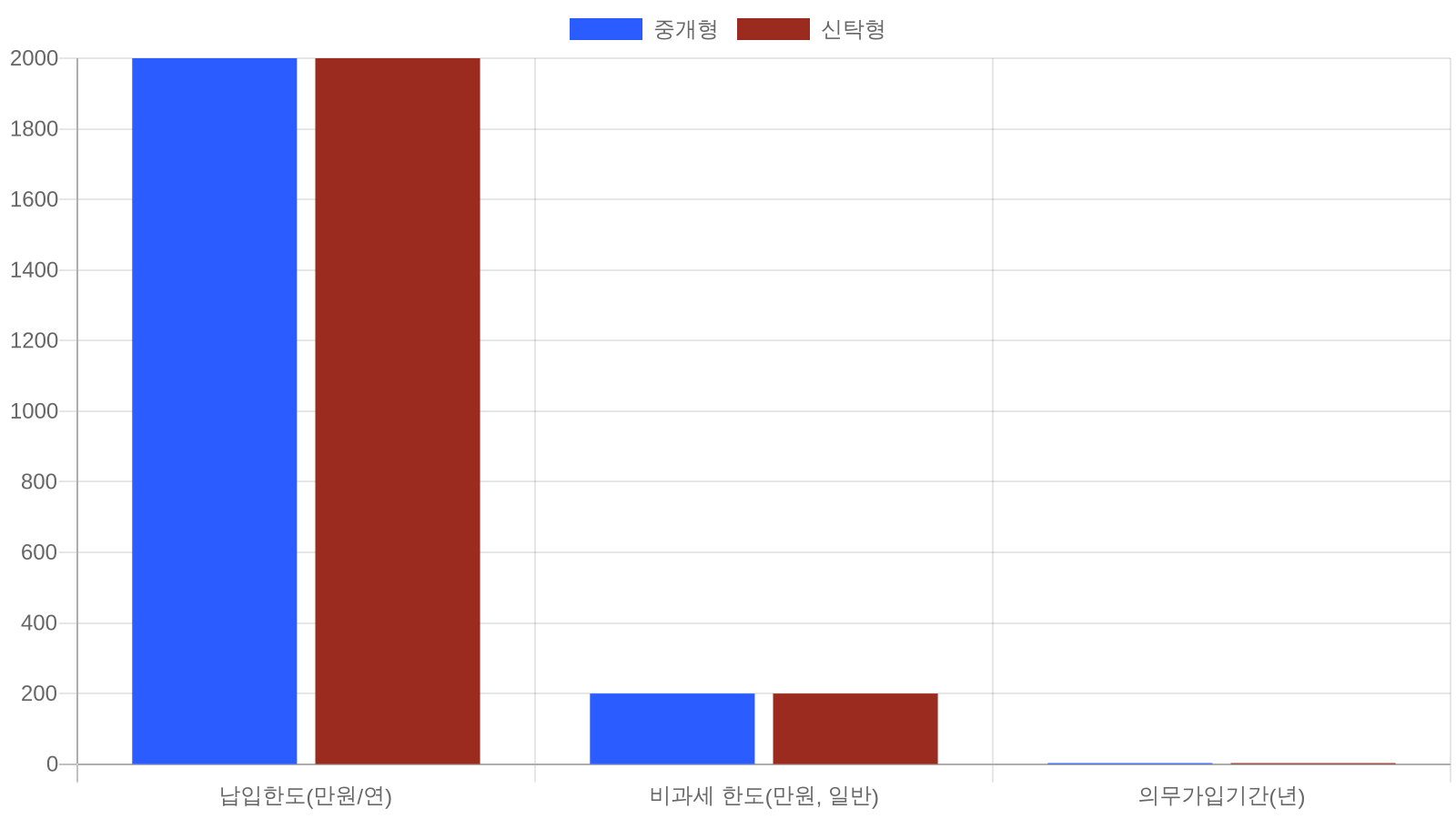
The tax benefit framework is identical for both types. Annual contribution limit of 20 million won (up to 100 million won cumulative), mandatory holding period of 3 years, tax exemption on net profit up to 2 million won (4 million won for low-income or agricultural residents) after netting gains and losses within the account, and a separate 9.9% tax rate on the excess. There is no difference between the two types on these points.
Core Comparison: What Actually Differs
The table below summarizes the key differences between the two types. Since tax conditions are identical, the practical decision criteria narrow down to "what assets will you invest in" and "how will you bear the costs."
| Item | Trust Type | Brokerage Type |
|---|---|---|
| Eligible institutions | Banks, securities firms, insurance companies | Securities firms only |
| Direct trading of domestic listed stocks | Not permitted | Permitted |
| Eligible products | Deposits, funds, ETFs, REITs | Deposits, funds, ETFs, REITs, domestic stocks |
| Managing party | Financial institution (trust agreement) | Account holder directly |
| Fee structure | Trust fee (varies by product) | Trading commission |
| Annual contribution limit | 20 million won | 20 million won |
| Tax-exempt limit (general type) | 2 million won | 2 million won |
| Mandatory holding period | 3 years | 3 years |
| Separate tax rate on excess | 9.9% | 9.9% |
As the table reveals, the tax conditions of both types are completely identical. The practical decision hinges on three things. First, do you want to directly manage domestically listed stocks within the ISA? Second, will you keep a banking relationship while using the ISA, or consolidate assets around a securities firm? Third, which cost structure — trust fee or trading commission — is more favorable given your investment pattern?

Choosing an ISA type should be determined not by the size of the tax benefit, but by what assets you will manage and how.
Key Context to Address Before Switching
Changing from trust type to brokerage type — or vice versa — requires closing the existing account and opening a new one. Be aware that the cumulative contribution limit does not reset. The ISA annual contribution limit is 20 million won, and unused amounts from prior years can be carried forward and deposited all at once as a "carryforward contribution." However, the contribution history accumulated in the closed account does not transfer to the new one; the new account starts its contribution history from scratch. In other words, the amount and period contributed up to the point of closing start over for purposes of calculating tax benefits.
The mandatory holding period of 3 years also resets upon closing. For example, if you maintained a trust-type account for 2 years and then switch to brokerage type, the mandatory period for the new account starts over at 3 years. To receive the tax-exempt benefits, you must complete a minimum of 3 years based on the new account. For switching to be worthwhile, the investment convenience of the new type must outweigh the loss of time and contribution limits from re-enrolling.
Also, transferring between financial institutions (within the same type) and changing types (brokerage ↔ trust) are completely different procedures. If you want to change firms within the same type, you can use a transfer service without closing the account. But changing the type itself has no option other than closing and re-enrolling. Therefore, it is important to first clarify whether you want to "change securities firms" or "switch to the brokerage type itself."
What to Watch
- Confirm current ISA type: Check the account type (brokerage/trust) and accumulated contribution amount through your financial institution's app or the Financial Settlement Institute's "AccountInfo" service.
- Remaining mandatory holding period: Calculate the 3-year maturity date from the account opening date. Closing before maturity triggers a retroactive clawback of tax benefits, so it is generally more advantageous to time the switch after maturity.
- Check carryforward contribution limit: Confirm how much unused contribution from prior years can be carried forward. When re-opening after closure, this carryforward limit resets — so it may be rational to fully utilize the existing account's limit before switching.
- Type of assets you plan to invest in: If you want to directly trade domestically listed stocks, brokerage type is the only option. If you focus on ETFs and funds, trust type remains an alternative.
- Fee structure comparison: Compare the trust fee rate for trust type and the stock/ETF trading commissions at brokerage-type firms against your expected trading frequency. For long-term holding, the fee level matters most; for frequent short-term trading, the trading commission is the more important cost variable.
- Eligibility for low-income type: If your prior-year earned income is 50 million won or less, or comprehensive income is 38 million won or less, you qualify for the low-income type, which doubles the tax-exempt limit to 4 million won. If you meet this requirement, confirming this limit is a higher priority than the account type.
- Policy change monitoring: The government has adjusted ISA contribution limits and tax-exempt limits multiple times. Periodically check announcements from the Financial Services Commission and Ministry of Economy and Finance to confirm whether the currently applicable figures have changed.