
The most common question US stock investors ask every May during comprehensive income tax season is simple: "How much do I have to earn before taxes kick in?" The starting point of the answer is the annual basic deduction of 2.5 million won. How you design around this number determines the actual tax you pay on the same profit. Understand three variables — sell timing, stock selection, and the order of gain-loss netting — and tax-saving becomes an art of calculation rather than an art of timing.
The Skeleton of the Tax Structure: How the 2.5 Million Won Works
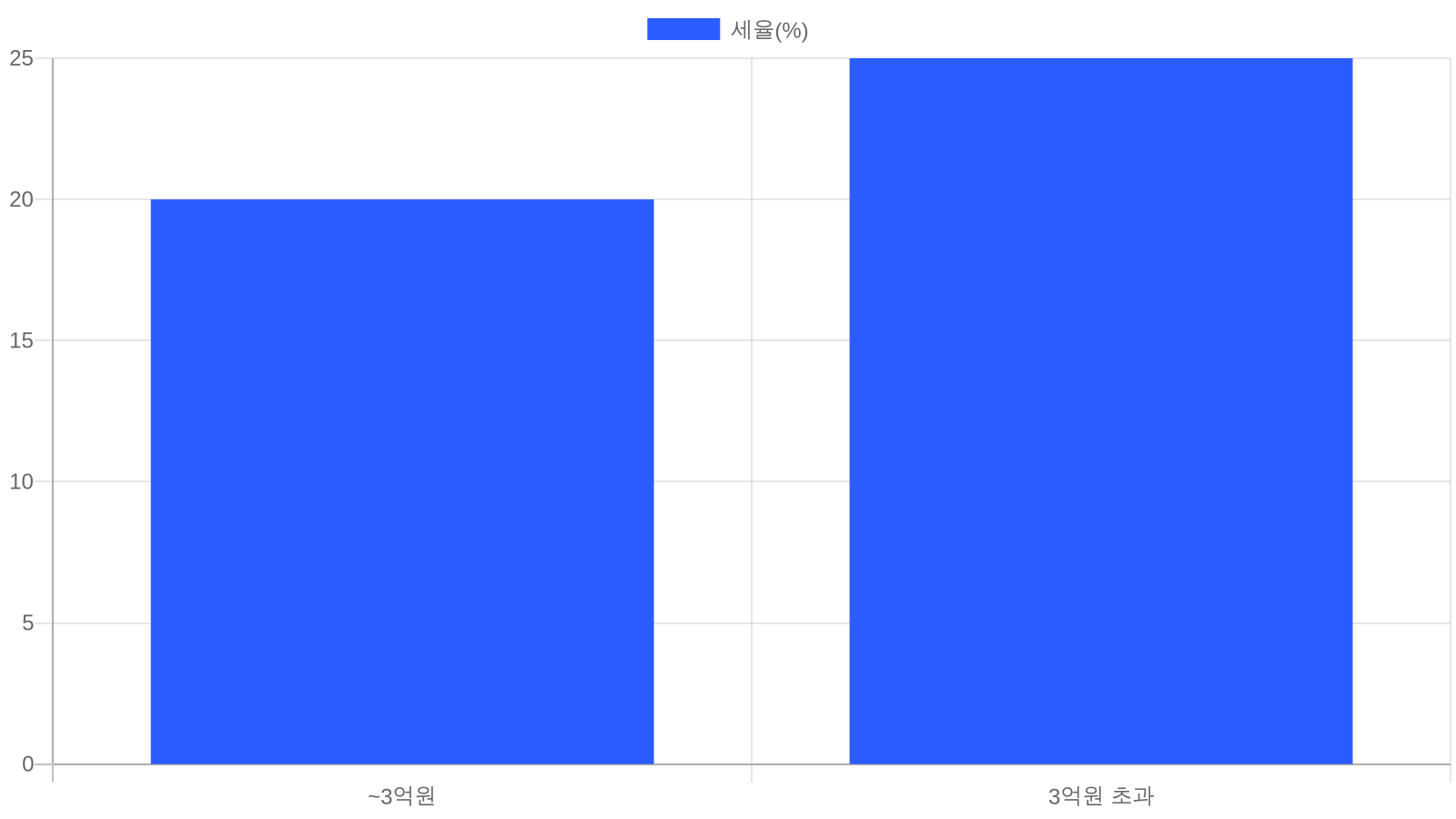
Under Korean tax law, gains realized on overseas stocks (including US stocks) are taxed as capital gains tax regardless of ongoing discussions about the financial investment income tax transition. The taxation flow is as follows. First, all overseas stock capital gains realized during the tax year (January 1 through December 31) are totaled. Capital losses are then subtracted to arrive at "net profit," and the annual 2.5 million won basic deduction is applied to determine the taxable base. The tax rate is 20% on taxable income up to 300 million won, and 25% on the portion exceeding 300 million won. Including the local income tax (10% of the tax amount), the effective rates are 22% and 27.5% respectively.
The key is the "realization date." Simply holding US stocks does not trigger taxation. Only the year in which you sell and lock in a gain is a taxable event. Therefore, strategies such as selling some positions before year-end to keep profits at or below 2.5 million won, or selling loss-making stocks to offset gains, are meaningful. Conversely, if profits have already greatly exceeded 2.5 million won, it may be advantageous to defer additional sales to the following year.
One important point is that the 2.5 million won basic deduction applies "once per person per year." If spouses each maintain separate accounts, they can each use their own 2.5 million won deduction — a household-level deduction effect of 5 million won per year. This is a factor worth explicitly considering in the account structure design phase for long-term portfolios.
Gain-Loss Netting and Sell Design: Calculate First, Sell Later
The concept most often missed in tax-saving sales is "gain-loss netting." If you realize a 5 million won gain on Stock A and a 2 million won loss on Stock B in the same year, your net profit is 3 million won. Applying the 2.5 million won deduction leaves a taxable base of only 500,000 won. The tax is 500,000 won × 20% = 100,000 won, or 110,000 won including local income tax. But if you hold Stock B without realizing the loss that year, the taxable base becomes 2.5 million won (5 million won gain minus 2.5 million won deduction), and the tax rises to 550,000 won.
Using this structure in reverse makes it possible to design a strategy of "locking in small profits each year with no tax." For example, calculate your realized gains and losses by mid-December — if your profit is around 2 million won, you can realize a little more profit (up to 500,000 won), or sell loss positions with less than 500,000 won in unrealized losses to fully utilize the deduction limit. Repeating this process every year allows you to distribute the realization of long-accumulated unrealized gains while minimizing the tax burden.
However, there is a caveat about selling a position and immediately repurchasing the same stock (wash sale). While Korean tax law does not have an explicit rule against this like the US does, one should keep in mind that if the tax authority deems the purpose to be tax avoidance, the interpretation may differ. Tax-motivated sell-and-repurchase strategies are generally safer when confirmed with a tax accountant based on individual circumstances.

Three Traps Easy to Miss
The first is the exchange rate illusion. The acquisition cost and sale price of overseas stock capital gains are each converted to Korean won using the base exchange rate (or arbitrage rate) at the time of the transaction. Even if there is no gain in dollar terms, if the won has weakened since purchase, the exchange rate appreciation can create a taxable gain. Conversely, even if there is a dollar-denominated gain, a won-denominated loss is possible. Before selling, you must always recalculate gains and losses in won terms.
The second is the omission of filing. Overseas stock capital gains tax is not subject to year-end tax settlement. Taxpayers must file and pay directly during the comprehensive income tax season in May each year. This differs from how securities firms automatically withhold domestic stock transaction taxes at the source. Even if profits are below 2.5 million won and the tax payable is zero, you should check whether a filing obligation arises (the general interpretation is that there is no filing obligation when the taxable base is zero, but filing is advantageous for error prevention).
The third is confusion with dividend income. US stock dividends are subject to 15% withholding at source in the US, and this is separate from the capital gains tax — the question of whether it is subject to comprehensive income tax aggregation or separate taxation must be judged independently. The 2.5 million won basic deduction applies only to "capital gains" and does not apply to dividend income.
| Item | Details |
|---|---|
| Basic deduction | 2.5 million won per year (1 person, 1 year, 1 time) |
| Tax rate (taxable base up to 300 million won) | 20% (22% including local income tax) |
| Tax rate (taxable base over 300 million won) | 25% (27.5% including local income tax) |
| Calculation currency | Won conversion (base exchange rate on transaction date) |
| Filing period | Comprehensive income tax season in May of the following year |
| Gain-loss netting scope | Overseas stock capital gains and losses within the same year |
| Basic deduction applied to dividend income | Not applied (separate tax system) |
Conditions Under Which This Outlook May Break Down
The current tax-saving calculation is sensitive to changes in the financial investment income tax system. If overseas stock capital gains are incorporated into the financial investment income tax framework through domestic legislation, the deduction amount, rate structure, and gain-loss netting scope could change. Additionally, changes in US tax rates (discussions on raising US capital gains taxes), revision of the Korea-US tax treaty, or clarification of wash sale rules by tax authorities could partially modify the current calculation structure. Checking for tax law amendments before filing each tax year is essential.
The 2.5 million won deduction is not an art of sell timing — it is an arithmetic art of calculating won-denominated gains and losses before year-end and designing the order of sales.
What to Watch
- Mid-year check on realized gains and losses: Calculate how much your won-converted net profit exceeds 2.5 million won as of early December.
- List of loss positions: Among your holdings with unrealized losses, identify which can be sold by year-end to offset gains.
- Exchange rate direction: If the won/dollar rate rises toward year-end, won-denominated gains increase — manage dollar-based and won-based gains and losses separately.
- Spouse account distribution: If your spouse also has an overseas stock position, confirm whether each can independently use the 2.5 million won deduction.
- Financial investment income tax legislation trends: Monitor discussions at the National Assembly's Strategy and Finance Committee and the timing of tax reform bill announcements (typically July–August).
- Filing deadline and method: Schedule in advance whether to file directly via Hometax or through a tax accountant during the comprehensive income tax season in May of the following year.
- Dividend income aggregation: If US stock dividend receipts exceed 20 million won per year, they may be subject to comprehensive financial income taxation — check separately from capital gains.