
An account that falls below the 140% maintenance ratio is not sold that same day. The broker demands additional collateral on the next trading day, and if it is not posted, the system sells automatically at the open of the day after. Two sessions sit between the crash and the liquidation. On 28 July the KOSPI closed at 6,023.63, down 732.12 points or 10.84%, after sidecars and circuit breakers fired on both boards. The next day, forced selling reached 61.1 billion won, 4.4 times the 13.9 billion won of the previous session, and forced sales as a share of unpaid settlement balances jumped from 1.3% to 5.0% (Hankook Ilbo). What decides whether an account is liquidated is not how far the index fell in a day, but how much of the position was bought with borrowed money.

Exactly which day does forced selling happen?
Two different clocks run here. In misu trading (a short settlement-period margin buy), the investor posts only a deposit on the trade date and must fund the rest by the T+2 settlement day; if the cash is missing, the position is sold on T+3. With shinyong yungja (broker margin loans), the trigger day (D) is the day collateral value slips below the maintenance ratio, notice goes out on D+1, and unfunded accounts are liquidated automatically on D+2 (KB Think).
That is why crash days and liquidation days do not line up. An account broken on the 28th is notified on the 29th and sold on the morning of the 30th. It also explains supply hitting the market on days when the index rebounds. The reverse holds too: if prices recover within the notice window and collateral value climbs back above the line, nothing is sold. The two-day lag is both a risk and a reprieve.
How far must the price fall to break 140%?
The maintenance ratio is collateral value divided by the loan amount. Because the shares bought on margin are themselves the collateral, the threshold depends only on f, the loan's share of the total purchase: threshold drop = 1 - 1.4 x f. The table below applies that to a 100 million won position.
| Loan (10k won) | Own funds (10k won) | Loan share f | Value at the 140% line (10k won) | Threshold drop (%) |
|---|---|---|---|---|
| 4,000 | 6,000 | 0.40 | 5,600 | 44.0 |
| 5,000 | 5,000 | 0.50 | 7,000 | 30.0 |
| 6,000 | 4,000 | 0.60 | 8,400 | 16.0 |
| 6,500 | 3,500 | 0.65 | 9,100 | 9.0 |
| 7,000 | 3,000 | 0.70 | 9,800 | 2.0 |
An account loaded to the limit on a stock with a 40% deposit requirement is short of collateral after a 2% decline. An account that keeps borrowing at 40% of the total survives a 44% drawdown. On 28 July Samsung Electronics fell 13.39% and SK Hynix 14.65% — the same tape, opposite outcomes, decided by that single line of arithmetic.
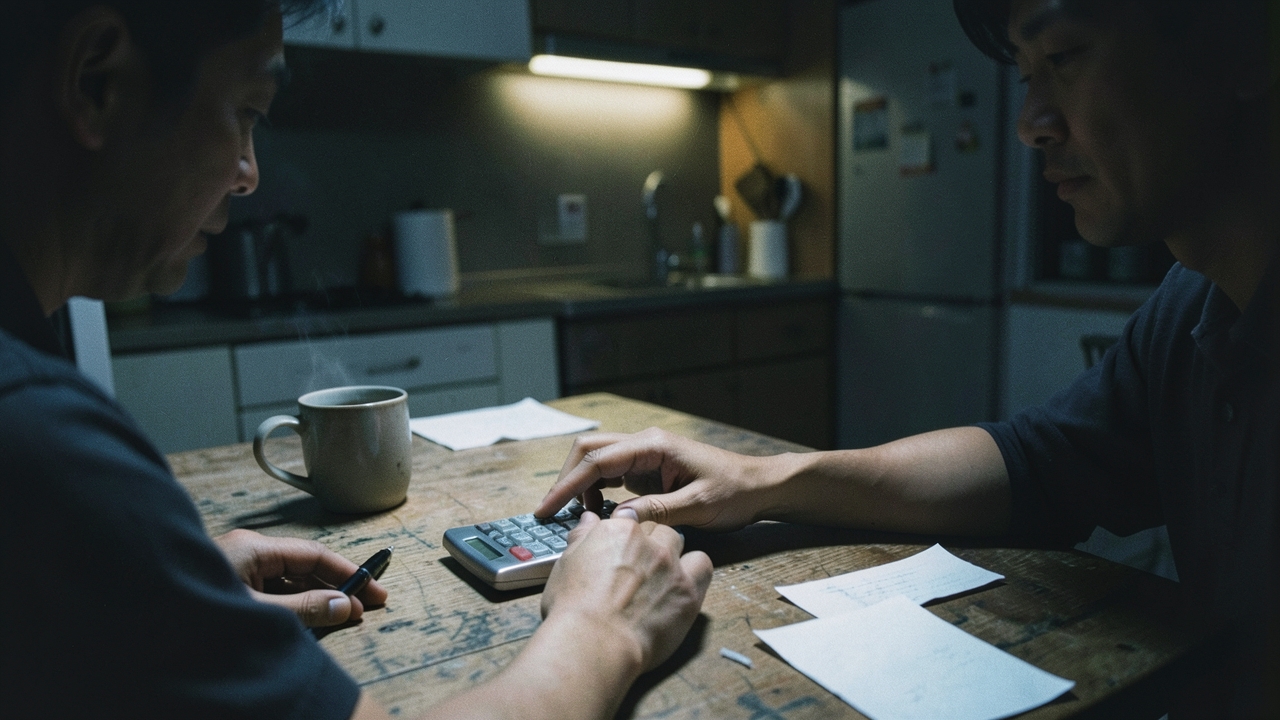
The crash does not kill the account. The sell button that presses itself two days later does.
Why a 4 million won shortfall sells 5.71 million won of stock
Forced selling does not stop at the shortfall. Orders are priced at up to a 30% discount to the previous close, so the amount actually sold equals the shortfall divided by 0.7. Applied to an account with a 60 million won loan on a 100 million won position:
| Price drop (%) | Collateral value (10k won) | Required at 140% (10k won) | Shortfall (10k won) | Sold at 30% discount (10k won) |
|---|---|---|---|---|
| 16 | 8,400 | 8,400 | 0 | 0 |
| 20 | 8,000 | 8,400 | 400 | 571 |
| 25 | 7,500 | 8,400 | 900 | 1,286 |
| 30 | 7,000 | 8,400 | 1,400 | 2,000 |
At a 30% decline, 29% of the remaining collateral value goes to market in one order. The discount is the position size. Leverage products accelerate it: EBN counted 6.81 trillion won in leveraged products tracking Samsung Electronics and SK Hynix, with ETFs down 25.91-29.10% and ETNs down 26.90-29.27% in a single session.

The numbers sitting in the market at the end of July
Margin loan balances stood at 32.995 trillion won on the 29th, with unpaid settlement balances around 1.078 trillion won, split between 25.836 trillion on the main board and 6.906 trillion on KOSDAQ. The balance has already fallen from its late-June peak; what matters next is whether it shrinks through voluntary repayment or through liquidation.

What to watch
- The daily change in margin loan balances published by the Korea Financial Investment Association — sustained drops above 1 trillion won a day point to liquidation, not repayment
- Forced sales as a share of unpaid balances — whether it retreats from 5.0%, and for how many sessions
- Investor deposits — rising deposits with falling balances means repayment; both falling means liquidation
- Broker notices on deposit requirements and collateral valuation rates; moving a stock to a 100% deposit requirement squeezes existing accounts too
- Selling volume in the first 30 minutes of the session, where automatic liquidations cluster
Sources
- Sidecar then circuit breaker: KOSPI and KOSDAQ plunge together (Hankyung)
- KOSPI down 11%; monthly decline exceeds the IMF crisis (Newspim)
- Forced selling up 340% as 33 trillion won of margin debt faces liquidation (Hankook Ilbo)
- Forced selling triples; 6.8 trillion won of leverage faces a second shock (EBN)
- What forced selling means: timing and thresholds for margin trades (KB Think)