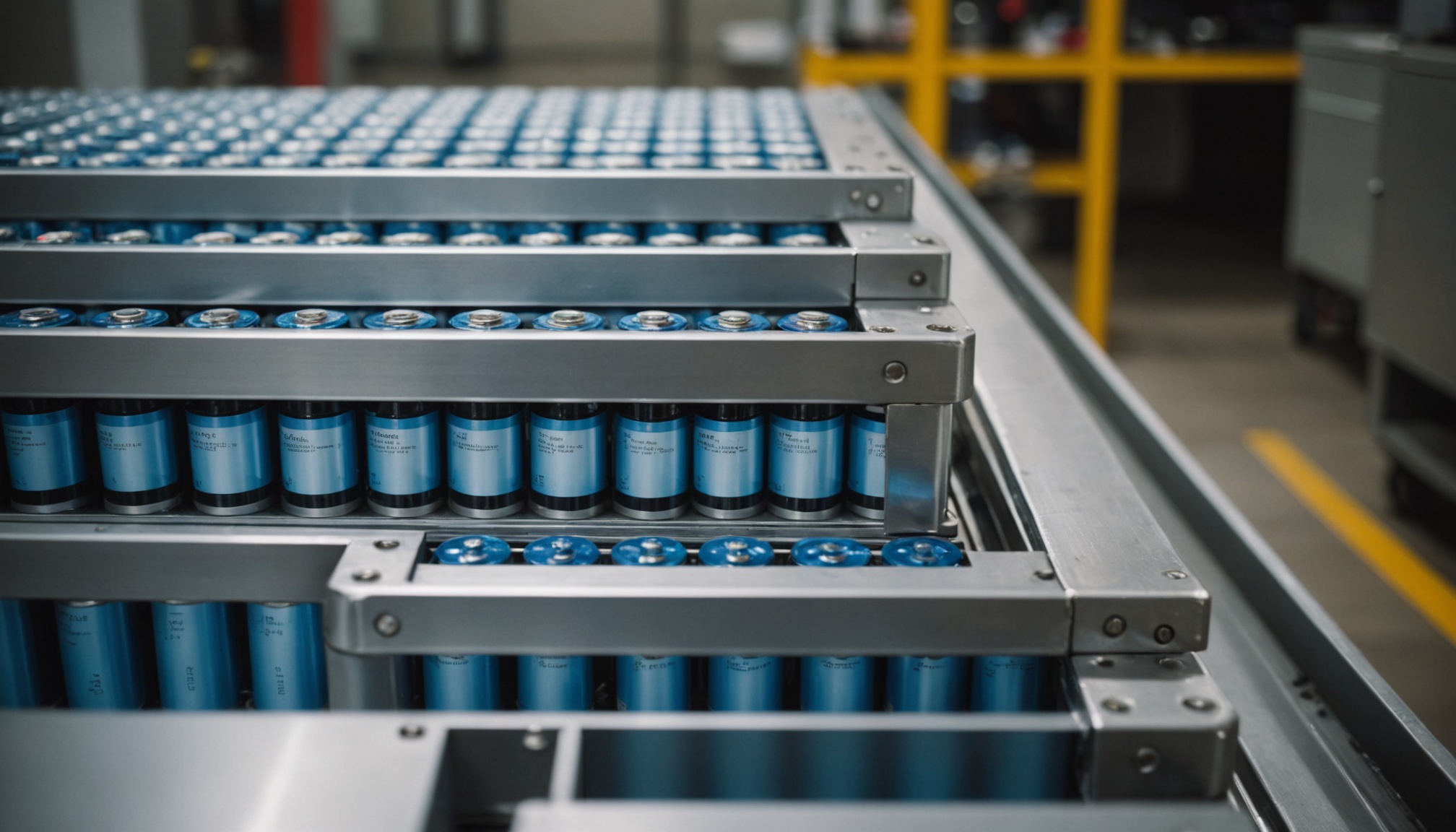
When solid-state batteries first reach commercial vehicles, they are projected to cost roughly five to six times as much as today's lithium-ion cells. BloombergNEF puts the average EV battery pack price at $105 per kWh this year, so filling a 75kWh pack with solid-state cells would push a $7,875 cost toward $40,000. Announcements pinning down mass-production years have piled up, but the number that actually matters in a roadmap is not the year — it is when that multiple comes down.
Getting from 5x to 2x is not a materials-discovery problem. It is a problem of process yield and raw-material pricing. So when reading these announcements, look first at what grew by how many times, not at what year was promised.

What 5-6x Actually Means on a 75kWh Pack
BloombergNEF reported average EV pack prices falling from $115/kWh in 2024 to $108 in 2025, roughly 8%, and projects $105 for this year. The slowdown from an 8% drop to a 3% drop was attributed to persistently high raw-material costs and rising tariffs. Taking $105 as the base and applying the 5-6x early-commercialization multiple reported by Hankyung Money gives the following.
| Multiple vs. lithium-ion | 75kWh pack cost (USD) | Increase vs. lithium-ion (USD) |
|---|---|---|
| 1.0x (lithium-ion today) | 7,875 | baseline |
| 2.0x | 15,750 | +7,875 |
| 3.0x | 23,625 | +15,750 |
| 5.0x (low end of early launch) | 39,375 | +31,500 |
| 6.0x (high end of early launch) | 47,250 | +39,375 |
The arithmetic is plain: $105 × 75kWh = $7,875 as the base, multiplied out. Five times is $39,375; six times is $47,250. The increase alone runs $31,500 to $39,375 — roughly the price of an entire compact EV, added to the battery cost alone. That structure explains why early volumes have to start in low-volume segments with weak price resistance rather than mass-market cars.
There is a second trap: the denominator keeps falling. If lithium-ion pack prices slide from $115 in 2024 to $105 this year while solid-state costs do not fall as fast, the multiple can hold steady while the absolute gap widens. Just as an order backlog has to be read against how fast it converts into revenue (see how to read an order backlog), a cost multiple has to be read knowing its denominator is in motion.
Why Targets Split Between 2027 and 2030
Company targets are spread over more than three years. They share the label "solid-state," but each defines a different stage of commercialization.
| Company | Approach | Production / commercialization target |
|---|---|---|
| Samsung SDI | Sulfide-based | Mass production in 2027 |
| Toyota | Sulfide-based | EV commercialization 2027-2028 |
| CATL | - | Small-volume 2027, large-scale 2030 |
| LG Energy Solution | Graphite anode → anode-free | 2029 / 2030 |
| SK On | Sulfide-based (with Solid Power) | Commercialization in 2029 |
Samsung SDI is building and validating prototypes on a pilot line at its Suwon research campus. LG Energy Solution plans an interim graphite-anode product for 2029 and a true anode-free structure for 2030. SK On is co-developing with US-based Solid Power and completed a pilot plant in 2025. In short, the 2027 group means "cells come off a line, even in small volume," while the 2029-2030 group means "standard-format cells at scale." These are different events sitting side by side in the same table.
Expectations are large. According to Money Today, Korea's three major battery makers are accelerating toward a solid-state market projected at $40 billion by 2030. But the remaining obstacle industry sources consistently name is not performance — it is process stabilization and yield. The bottleneck is a manufacturing metric, not a spec-sheet one.

Where to Verify That Mass Production Is Real
Skip the press releases and watch two numbers. The first is the price of lithium sulfide, the feedstock for sulfide solid electrolytes. It currently runs in the hundreds of dollars per kilogram, and the industry view is that it must come down under $100/kg for commercialization to work — at least a two-thirds reduction. It is a price series you can check quarterly.
The second is the order of magnitude in materials suppliers' capacity plans. Converting announced expansions into multiples exposes the gap.
| Materials supplier | Current capacity (tons/yr) | Planned (tons/yr) | Expansion multiple |
|---|---|---|---|
| Isu Specialty Chemical | 40 | 150 | about 3.8x |
| POSCO JK Solid Solution | 24 | 7,200 | 300x |
A 3.8x plan and a 300x plan are different kinds of commitment. The former looks like scaling for prototypes and samples; the latter presumes volumes destined for finished vehicles. The real signal is when the unit in capacity announcements shifts from tons to thousands of tons — and, more importantly, whether follow-up disclosures confirm the lines actually running rather than merely planned. The gap between an announcement and a result shows up repeatedly, as in the case where record earnings and the share price moved in opposite directions.
A target year is a statement of intent. A cost multiple and the order of magnitude of materials capacity are a record of progress.
What to Watch
- Lithium sulfide price per kilogram — whether it drops from three digits to two, and when
- The unit in materials capacity disclosures — the shift from tons to thousands of tons, and follow-ups confirming operation rather than intention
- Announcements that pilot-line prototypes have moved into automaker qualification or supply agreements — building a prototype and passing qualification are separate events
- Further declines in lithium-ion pack prices — a falling denominator widens the absolute gap even at a constant multiple
- The condition under which this framework fails — if the multiple stays near 5x but adoption starts in defense, aerospace, or premium niches where price resistance is low, the announced years may hold while demand volume stays far smaller than expected. Treating "production starts" and "mass-market vehicles" as the same event hides that scenario