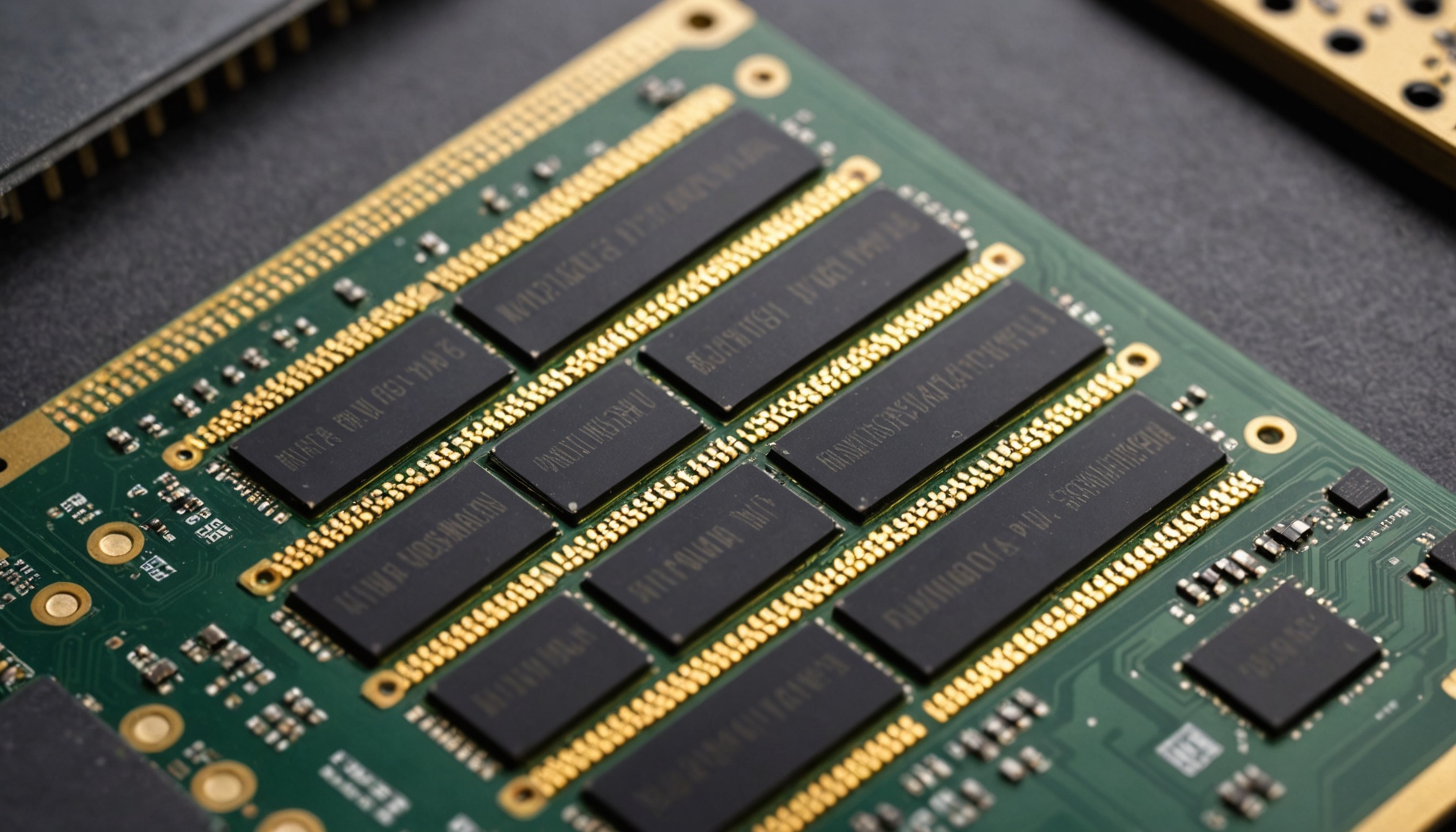
The DRAM contract price is what memory makers negotiate monthly with large PC and server customers. The spot price is what small lots change hands for on the open channel, every day. Because the two run on different clocks, a supply squeeze lifts the spot price first and the contract price follows. In June the contract price for PC-grade DDR4 8Gb averaged $21, while the July 1 spot price reached $36.10 — 71.9% above contract. The same chip carries two price tags, and the distance between them tells you where in the cycle you are standing.
What separates the two price tags
Contract pricing is bulk pricing. Volumes are large and negotiation cycles are long, so once a number is set it holds for the month. Spot pricing covers the small lots floating through distribution, and it moves daily. When channel inventory thins, spot jumps first; that pressure lands on the next negotiating table, and a month or two later contract prices follow.
Contract prices were already moving. PC-grade DDR4 8Gb went $16 in April, $20 in May, $21 in June — up 31.3% in two months. When the slow-reacting indicator climbs more than 30% in two months, the spot move has already migrated into contracts.
Which direction does a 72% gap point?
Dividing the July 1 spot price by the June contract price for matching specifications turns the gap into a multiple.
| Item | DDR4 8Gb (USD) | DDR4 16Gb (USD) |
|---|---|---|
| Contract price (June avg.) | 21.00 | 40.00 |
| Spot price (July 1) | 36.10 | 74.63 |
| Spot ÷ contract (x) | 1.72 | 1.87 |
| Gap (%) | +71.9 | +86.6 |
Spot above contract means buyers outside the contracted volume are paying a premium to secure parts. That points to thin channel inventory and gives suppliers grounds to raise the next contract. The reverse reads the same way: once spot slips below contract, inventory is piling up in the channel, and that month is a candidate for the top of the cycle.
Spot is the forecast; contract is the record. What matters is less how wide the gap opened than how many months it has stayed open — that is the length of the cycle.
Why older DDR4 costs more than newer DDR5
On the same day, DDR4 16Gb averaged $74.63 on the spot market against $46.83 for DDR5 16Gb — the older generation running 59.3% higher. That kind of inversion comes from supply being cut off rather than demand surging. Major memory makers have prioritized capacity for high-bandwidth memory (HBM) used in AI servers, and the first lines to shrink were commodity DRAM — especially DDR4, which is being phased out. Meanwhile replacement demand from existing PCs and industrial equipment cannot switch standards.
As a framework: a generational inversion measures the depth of a supply cut, not the strength of the cycle. If DDR5 is not rising alongside it, overall demand has not recovered — one specific line has simply run dry, and the durability of the rally should be discounted accordingly. For a case where reported results and market reaction moved in opposite directions, see the piece on a record earnings day that arrived with a sharp selloff.
Mixing Gb and GB breaks the math
Comparing the dollar figures in headlines directly is a trap, because units are mixed. On June contract pricing, DDR4 8Gb is $21 and DDR4 16Gb is $40, while the same report lists notebook DDR5 16Gb at $112. The first two are per-chip prices in gigabits; the last sits at module-level pricing.
Module figures make the distinction plain. As of late April, a DDR5 16GB module ran $201, up 41.55% from $142 the previous month, a DDR4 8GB module ran $119 (up 40%), and a DDR4 8Gb 2133MHz chip ran $16 (up 23.08%). Eight gigabits equal one gigabyte, and a single 16GB module carries eight 16Gb chips. So whenever a sentence says DRAM costs a certain number of dollars, check bits versus bytes and chip versus module first. It is the same discipline used to decode spec notation in the comparison of LPDDR6 and LPDDR5X channel structure.

Putting the forecast into numbers
TrendForce raised its third-quarter DRAM price forecast from 8–13% to 15–20%, and its fourth quarter from 0–5% to 3–8%. Compounding those onto the June contract price of $21 gives a year-end figure.
| Scenario | Q3 increase (%) | Q4 increase (%) | Year-end DDR4 8Gb contract (USD) | Cumulative vs June (%) |
|---|---|---|---|---|
| Low end | 15 | 3 | 24.9 | +18.4 |
| Midpoint | 17.5 | 5.5 | 26.0 | +23.9 |
| High end | 20 | 8 | 27.2 | +29.6 |
The quarterly numbers look dramatic, but stitched together they land in a range of +18% to +30% versus June — smaller than the 31.3% already booked over the preceding two months. An upward revision reads like acceleration; converted into prices, it looks closer to a decelerating climb.
The conditions under which this reading fails
Added supply breaks the math above, and the largest variable is China. ChangXin Memory Technologies (CXMT) posted first-half revenue of 150.31 billion yuan (about 30.8 trillion won), up 873.64% year on year, with net profit of 77.605 billion yuan (about 16 trillion won), against a 2.33 billion yuan net loss in the same period last year. Monthly capacity is roughly 300,000 wafers, expanding past 600,000 once new fabs run.
CXMT is generally assessed as two to three generations behind the leaders — but the parts rallying right now are exactly that older commodity DRAM. Once the added capacity converts into shipments, spot will react before contract. So the date to watch is not the expansion announcement; it is the quarter in which wafer starts turn into shipments.

What to watch
- The spot-to-contract multiple — a month when it falls from the 1.7x range below 1.0x is a candidate turning point
- Whether the DDR4/DDR5 generational inversion resolves — DDR5 climbing back above DDR4 would signal the supply cut easing
- The direction of TrendForce quarterly revisions — upward or downward matters more than the level
- Month-over-month contract price gains, measured against the 31.3% booked from April to June
- The quarter in which CXMT's new fab converts wafer starts into shipments
- Any shift in the share of capacity allocated to HBM, including a decision to send lines back to commodity DRAM