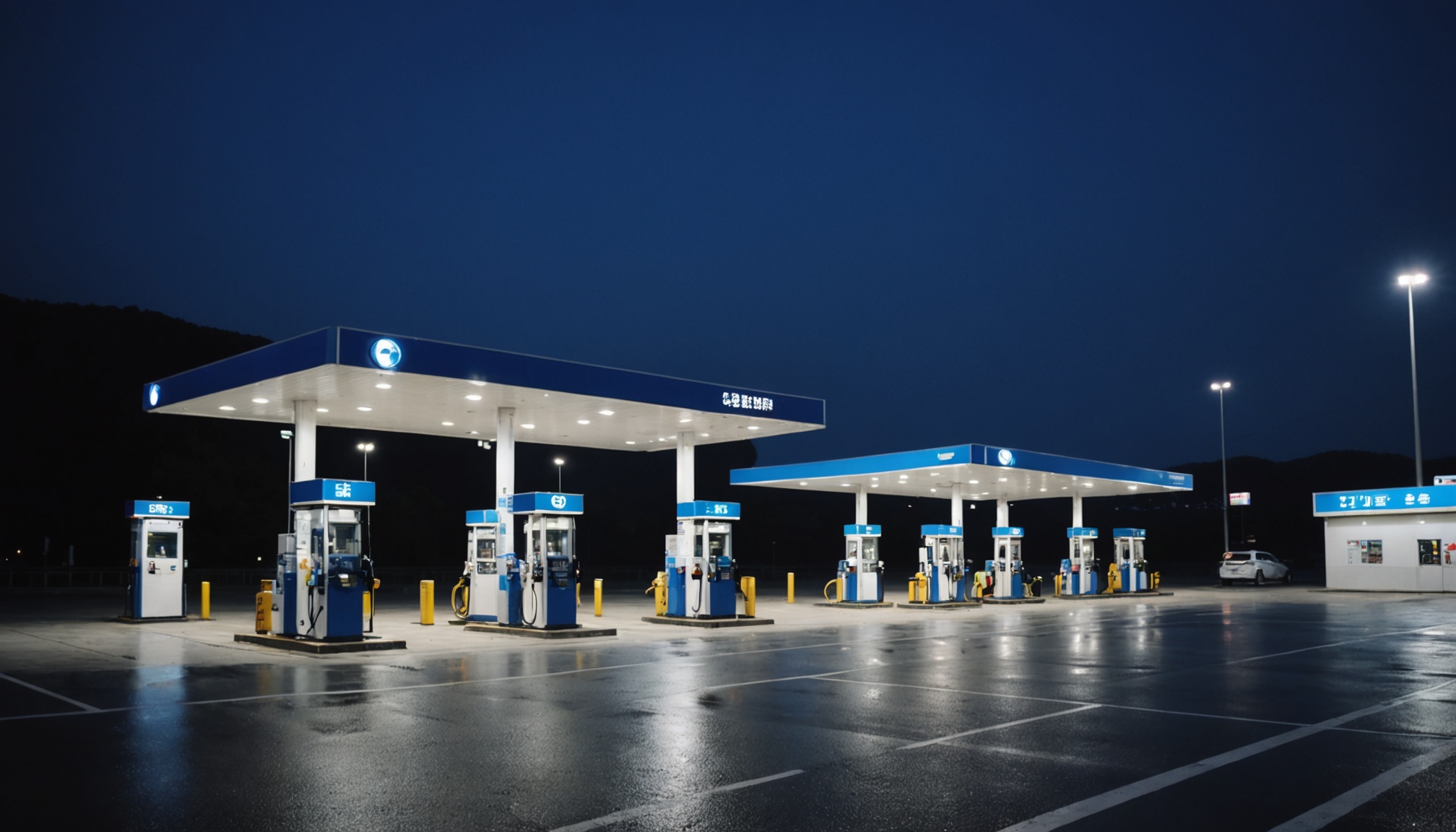
In the first week of September the national average pump price for gasoline in Korea was 1,860.2 won per liter, of which 697 won — 37.5% — was tax. Over the same week Dubai crude climbed $7.6 to $99.9 a barrel, yet domestic pump prices fell for a sixteenth consecutive week. The price on the board today reflects an international market that existed two to three weeks ago.
Layered on top of that is the temporary fuel tax cut, which expires on 30 September. If it is not extended again, 122 won per liter returns overnight. Add the pass-through of higher international product prices and roughly 200 won per liter of upward pressure is queued up.
What the 1,860 Won Is Actually Made Of
Fuel duty in Korea is a fixed amount per liter, not a percentage of the price. The base is the Transport, Energy and Environment Tax, on top of which sits an education surtax at 15% of that base and a local driving tax at 26% of it (TaxWatch). VAT of 10% is then applied to the whole retail price.
The flexible rate for the base duty is 529 won per liter. Through 30 September the government is applying a temporary cut of 15% on gasoline and 25% on diesel and butane (Financial News). The current gasoline figure shown on Opinet's fuel tax table is 450 won — the same number as 529 won less 15%, or 449.65 won.
Running that structure through gives the following before-and-after split.
| Item | Before cut (won/L) | With 15% cut (won/L) | Difference (won/L) |
|---|---|---|---|
| Transport, Energy and Environment Tax | 529.00 | 449.65 | -79.35 |
| Education surtax (15% of base) | 79.35 | 67.45 | -11.90 |
| Local driving tax (26% of base) | 137.54 | 116.91 | -20.63 |
| Fuel duty subtotal | 745.89 | 634.01 | -111.88 |
| VAT on the duty portion (10%) | 74.59 | 63.40 | -11.19 |
| Total tax | 820.48 | 697.41 | -123.07 |
The government's own figure is "122 won lower, at 698 won." The one-won gap against the 697.41 and 123.07 above comes from rounding the surtaxes to whole won. Either way, when the cut lapses, 122 won per liter is added regardless of what crude does.
Because the duty is a flat amount, its share moves inversely with the price. At 1,860.2 won the tax share is 37.5%; at a pump price of 1,500 won the same tax would be 46.5%.
How Long Until Crude Reaches the Pump
For the week of 30 August to 3 September, the national average was 1,860.2 won for gasoline, down 1.1 won, and 1,844.5 won for diesel, down 0.7 won — a sixteenth straight weekly decline. Seoul was the most expensive region at 1,906.6 won, while the discount Alddeul chain was cheapest at 1,851.0 won (Asiae).
The international numbers in the same report point the other way. Dubai crude rose $7.6 to $99.9 a barrel, international gasoline rose $8.8 to $120.8, and international diesel rose $8.1 to $159.2. Because crude has to be imported, refined and moved through distributors before it reaches a forecourt, changes in international prices typically take two to three weeks to show up at the pump.
What forecasts the pump price is not today's crude quote, but the international product price and exchange rate of two to three weeks ago.
Note that crude and product did not move by the same amount: Dubai rose $7.6 while gasoline rose $8.8. That spread is the refiner's margin, and the method for reading it is covered in our piece on calculating refining margins from the crack spread.
Converting $8.8 a Barrel Into Won per Liter
One barrel is 158.987 liters. An $8.8 increase per barrel is therefore $0.0554 per liter. Multiply by the exchange rate and add 10% VAT and you get the ceiling on how much can reach the consumer. Because the rate moves, three cases are shown.
| KRW/USD | Cost increase (won/L) | Including VAT (won/L) | Against 1,860.2 won |
|---|---|---|---|
| 1,300 | 71.96 | 79.16 | +4.3% |
| 1,400 | 77.49 | 85.24 | +4.6% |
| 1,500 | 83.03 | 91.33 | +4.9% |
This is a ceiling, not a forecast: it assumes full pass-through. In practice refiners and station operators absorb part of the move or delay it, depending on inventory cost and local competition. The 122 won from the expiring tax cut, by contrast, is set in law and arrives in full.
Together they point to roughly 200 won per liter of pending upward pressure after end-September. Three things would break that arithmetic: another extension of the tax cut removes the 122 won, a retreat in international product prices removes the pass-through, and the price cap discussed below can throttle how fast any of it moves.
A Price Cap on Refiners' Wholesale Prices
2026 added a variable Korea had never used before. The government is capping the price at which refiners sell to distributors under the petroleum maximum price system — a provision on the books since 1970 that was activated for the first time on 13 March 2026 (News1).
The seventh notice cut the ceiling by 150 won to 1,784 won for gasoline, 1,773 won for diesel and 1,380 won for kerosene (Korea.kr policy briefing). The ninth notice, announced on 21 August, held those same figures despite rising crude, and applies for four weeks from 22 August (Money Today).
One point is widely misread. The 1,784 won ceiling is not a cap on retail pump prices; it caps what refiners charge distributors and stations. That is why the national retail average of 1,860.2 won sits above it — rent, card fees and station margin are added downstream. The scheme squeezes input cost rather than the shelf price.

What to Watch
To read the direction early, watch the numbers upstream of the pump board rather than the board itself.
- International gasoline product price (Singapore) — leads domestic prices by two to three weeks. $120.8 a barrel is the current marker
- Opinet weekly average — the week the 16-week decline breaks is when the lag starts landing
- The 30 September duty notice — extension or not. Expiry adds 122 won to gasoline, 145 won to diesel, 51 won to butane immediately
- Each round of the maximum price notice — currently every four weeks, 1,784 won for gasoline at the ninth round. Raising it signals pass-through is being allowed
- KRW/USD — every 100 won of movement is worth 5 to 6 won per liter in input cost, per the table above
- Gap between discount stations and branded ones — 12.3 won in the first week of September. A widening gap means distributors have less room left to absorb
The same ordering applies when looking at refiners. A rise in crude alone is close to neutral for earnings; what sets the margin is whether the gap between product and crude widens. And while the wholesale cap holds, higher international product prices may not translate into wider domestic margins.

Sources
- Pump prices fall for 16th straight week as crude rises (Asiae)
- Fuel tax cut extended two months — 15% gasoline, 25% diesel and LPG (Financial News)
- Fuel tax guide (Opinet, Korea National Oil Corporation)
- A full breakdown of fuel taxes (TaxWatch)
- Petroleum maximum price system begins — a cap on refiners' wholesale prices (News1)
- Maximum price cut by 150 won to 1,784 won for gasoline (Korea.kr)
- Ninth maximum price notice freezes gasoline at 1,784 won (Money Today)