
Hanwha has won an order for two US Navy missile range instrumentation ships through its Philippine shipyard. According to Korea Economic Daily, the contract value is approximately 3 trillion won (roughly $2.2 billion). As a case in which an overseas subsidiary — not a domestic yard — is the direct contracting party for a US military vessel, this deal shows that K-defense's external expansion path is evolving from simple exports to a local manufacturing-and-order structure.
The Deal Structure: Hanwha Philippine Shipyard as the Contracting Party
The core of this order is that the contracting party is Hanwha Philippine Shipyard. The structure — in which the Korean parent provides technology while the overseas subsidiary contracts directly with the US Navy — can be read as exploiting the intersection of the US Defense Federal Acquisition Regulation (FAR) and allied-nation procurement policy. The fact that the US Navy is placing a shipbuilding order with an allied-nation shipyard is itself unusual, which suggests that diplomatic and policy groundwork played a role in making this contract happen.
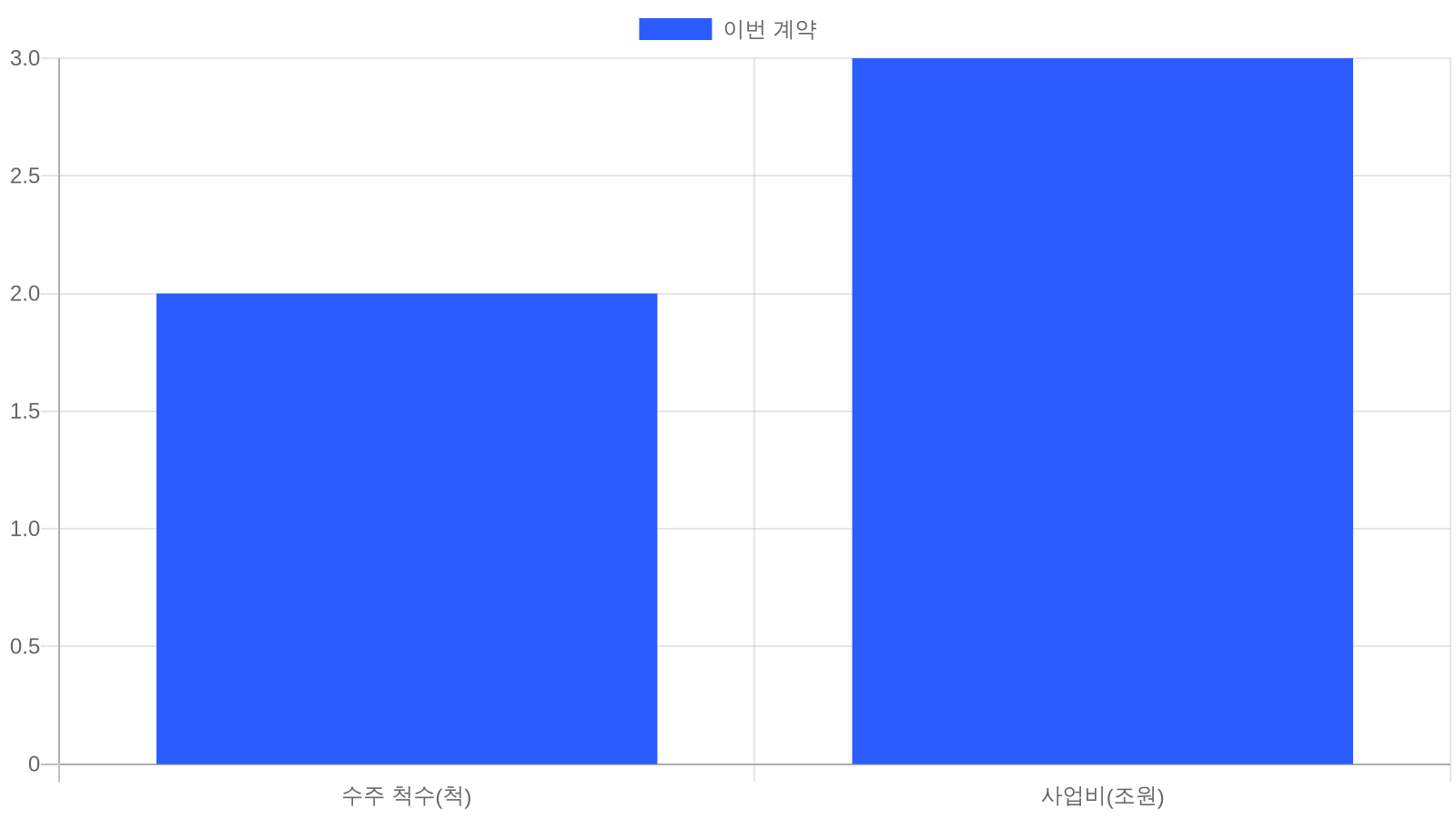
A missile range instrumentation ship is a special-purpose vessel supporting missile testing and evaluation. Its technical sensitivity is lower than a pure combat ship, but its operational precision requirements are quite high. At approximately 1.5 trillion won per vessel based on the 2-ship/3-trillion-won figures in the Korea Economic Daily report, this is a price point far above ordinary commercial vessels or auxiliary ships — a sizeable backlog secured by Hanwha Philippine Shipyard in one transaction.
The speed at which the backlog converts to actual revenue depends on the vessel construction schedule. Warships typically require years from contract signing to delivery, given the extended timelines for design changes, inspections, and testing. Therefore, viewing this 3-trillion-won order as an indicator that raises medium-to-long-term revenue visibility — rather than an immediate near-term earnings contributor — is the more accurate interpretation.
K-Defense Shipbuilding's Expansion Pattern: From Exports to Local Orders
The path along which Korean defense and shipbuilding companies grow overseas can be broadly divided into three stages: (1) export of finished products or technology licenses, (2) joint production through local joint ventures or subsidiaries, and (3) local subsidiaries independently winning orders and manufacturing. Hanwha Philippine Shipyard's US Navy contract approaches that third stage.
This pattern matters because the structure of market access and risk distribution changes. In a direct-export-from-parent structure, the importing country's tariffs, regulations, and political risks strike at the contract stage. In a local-subsidiary order structure, the counterparty may be able to treat the contract more like domestic procurement, and there is also a potential benefit of being integrated into the US defense supply chain ecosystem.
However, this structure does not automatically mean improved profitability. Local labor and procurement costs, the regulatory environment in the Philippines, and the cost of US Navy quality inspection all factor into costs. How much profitability Hanwha can secure under this structure must be confirmed through subsequent disclosures of backlog figures and segment-level margins in annual reports.
The moment an overseas subsidiary became the direct contracting party for a US military vessel contract, the grammar of K-defense expansion turned a page — from "exports" to "local orders."
Conditions Under Which This Deal Could Go Wrong
Scenarios that could reverse the optimistic reading must also be considered. First, if US allied-nation procurement policy changes, the probability of follow-on contracts drops sharply. The prevailing interpretation is that the US Navy's willingness to place orders with allied-nation shipyards is structurally driven by insufficient domestic US shipbuilding capacity. If the US aggressively pursues in-shoring of shipbuilding, the window for overseas-subsidiary orders could narrow. Second, there is geopolitical risk in the Philippines itself. If the South China Sea dispute intensifies or political change occurs within the Philippines, the US Navy may reconsider continuing to entrust strategic vessel construction to shipyards in that region. Third, if Hanwha Philippine Shipyard's actual construction capability repeatedly fails to meet US Navy inspection standards, contract delays or penalties could result. All three conditions must hold for the 3-trillion-won order to translate into real profit.
| Item | Detail |
|---|---|
| Contracting party | Hanwha Philippine Shipyard (local Philippine subsidiary) |
| Client | US Navy |
| Vessel type | Missile range instrumentation ship |
| Number of vessels | 2 |
| Contract value | Approx. 3 trillion won (~$2.2B) |
| Price per vessel | Approx. 1.5 trillion won (~$1.1B) |
What to Watch
- Hanwha annual report backlog line items: Confirm which segment the Philippine Shipyard backlog is classified under and when revenue recognition is expected to occur.
- US Navy allied-nation procurement policy trends: Monitor official statements and budget proposals from the US Congress or the Naval Sea Systems Command (NAVSEA) regarding use of foreign shipyards.
- Follow-on orders for the Philippine shipyard: The key indicator confirming whether this contract is a one-off or a springboard leading to follow-on program bids.
- Scale of Hanwha's overseas defense asset investment: The overseas base investment flow across the Philippines, Poland, Australia, and other sites must be viewed in aggregate to gauge the execution capability of the local-order strategy.
- US–Philippines security cooperation level: South China Sea tensions and the reliability of the US–Philippines alliance tie directly to the sustainability of this order structure.
- Competitor moves: Whether HD Hyundai Heavy Industries and other domestic or international rival shipyards are pursuing similar US Navy contracts is the benchmark for judging the durability of Hanwha's structural competitive advantage.