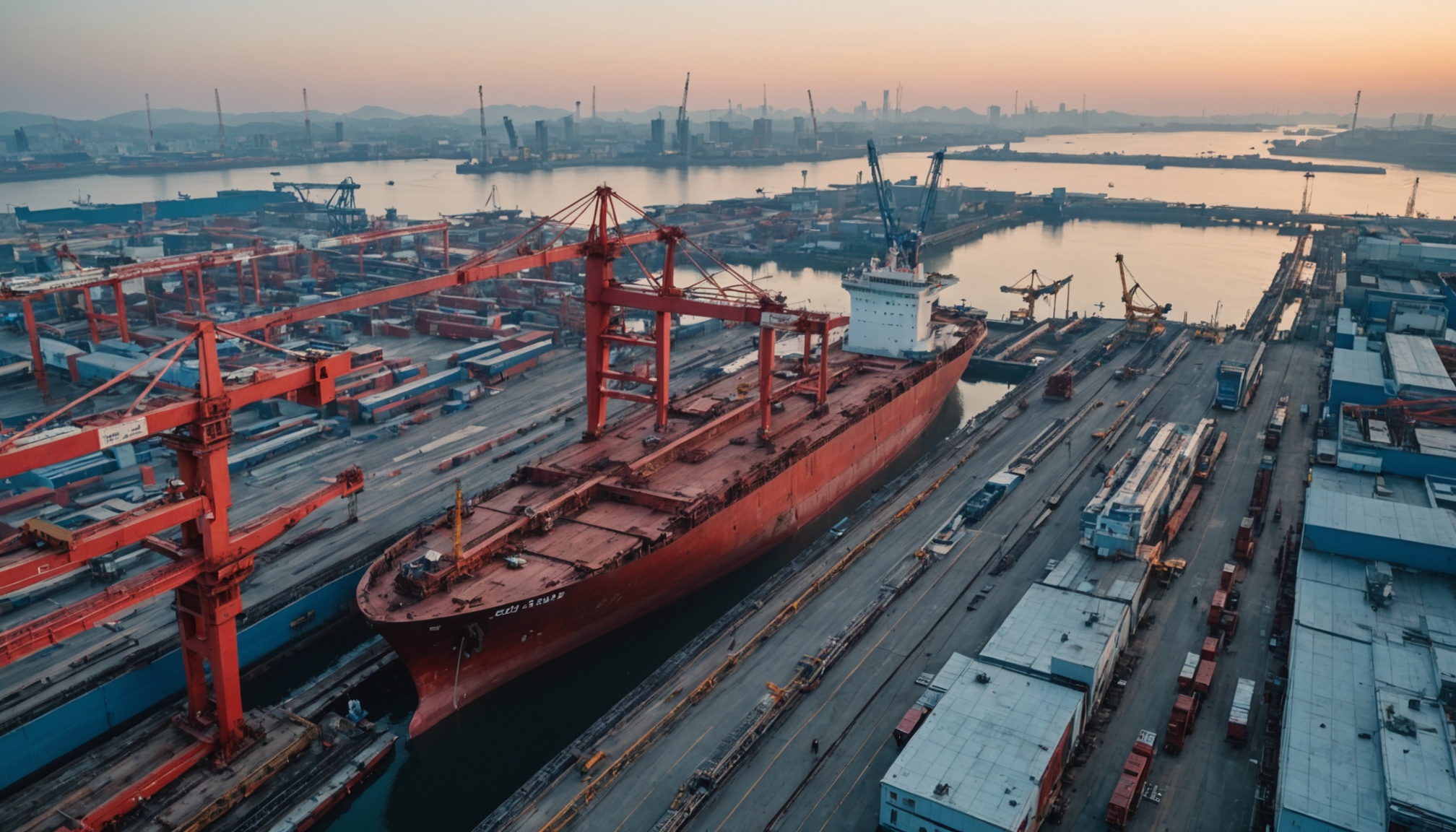
An order backlog is a contract total, not revenue for the year. Per figures relayed by the Korea International Trade Association, the domestic shipbuilding backlog stood at $137.285 billion — about 189 trillion won — at the end of May. The same three builders booked combined 2025 revenue of 53.37 trillion won. Divide one by the other and you get roughly 3.5 years of work in hand. Flip it around and it means a contract signed today takes about that long to work its way fully through the income statement.
In order-driven industries like shipbuilding, construction and plant engineering, earnings are decided not by when the contract was signed but by how much cost has been poured in so far. Follow only the order announcements and reported earnings will always look one beat out of step. Learn the grammar of percentage-of-completion, though, and the already-disclosed backlog sketches a rough floor for revenue over the next several years.
189 Trillion Won of Backlog — How Many Years of Work?
The simplest yardstick is backlog divided by annual revenue: how many years it would take to burn through at the current pace. Backlog figures come from the end-of-May KITA tally in won terms; revenue comes from the confirmed 2025 results compiled by Monthly Maritime Korea. The two are measured at different dates, so treat this as a sense of scale rather than a precise financial ratio.
| Company | Backlog (tn won) | 2025 revenue (tn won) | Backlog ÷ revenue (yrs) | 2025 operating profit (tn won) |
|---|---|---|---|---|
| HD Korea Shipbuilding | 104 | 29.93 | 3.5 | 3.90 |
| Samsung Heavy Industries | 43 | 10.65 | 4.0 | 0.86 |
| Hanwha Ocean | 42 | 12.78 | 3.3 | 1.17 |
| Three-company total | 189 | 53.37 | 3.5 | 5.93 |
What matters is how tightly the three cluster, from 3.3 to 4.0 years. HD Korea Shipbuilding's backlog is 2.4 times Samsung Heavy's, yet in years of work Samsung Heavy actually runs longer. A bigger absolute backlog does not mean a longer runway. When this multiple drifts toward 1, next year's revenue is short of work to fill it; above 4, the docks are already booked and the yard can be selective about new orders.

Cost Incurred, Not Cash Received, Creates Revenue
A ship does not become revenue the moment it is contracted, nor all at once on delivery. As the Korea Listed Companies Association explains in its commentary on K-IFRS 1115, a contract that builds an asset the customer controls as it is created is treated as a performance obligation satisfied over time, with revenue recognized in proportion to progress. Korean shipbuilders measure that progress with an input method based on cost incurred: actual cost to date divided by total estimated cost.
Take a vessel contracted at 100 billion won with total estimated cost of 85 billion won and a four-year build. Feed in nothing but a cost-spending schedule and the split of profit falls out on its own.
| Year | Cost incurred (bn won) | Cumulative progress (%) | Revenue recognized (bn won) | Profit recognized (bn won) |
|---|---|---|---|---|
| Year 1 | 8.5 | 10 | 10.0 | 1.5 |
| Year 2 | 21.25 | 35 | 25.0 | 3.75 |
| Year 3 | 34.0 | 75 | 40.0 | 6.0 |
| Year 4 | 21.25 | 100 | 25.0 | 3.75 |
The year the order is won produces 10 billion won of revenue, not 100 billion, and just 1.5 billion of profit — design and early procurement simply do not consume much cost yet. More than half arrives in years three and four. The point that trips people up is payment. Whenever the advance, progress and delivery instalments land, that is a cash-flow question; revenue splits purely on the cost ratio above. That is why operating cash flow and operating profit routinely diverge in this sector.
An order is a promise about the future; percentage-of-completion is an invoice for the present. The income statement only ever reads the second one.
Today's Earnings Come From Orders Won Two or Three Years Ago
According to Dailian, a ship typically takes two to three years from order to delivery. So today's margin is set by ship prices from two or three years ago, not today's. Consensus second-quarter 2026 operating profit for the three builders came to 2.34 trillion won, up about 53% year on year — and what sits inside that number are the high-priced LNG carriers and large container ships contracted in 2022 and 2023. Analysts reckon only about half of the orders taken since 2024 have entered construction, which is why the high-price effect is expected to run through 2028.
This structure also explains cases where a record earnings release moves the share price the other way. The good result was locked in by contracts signed two or three years earlier; the genuinely new information for the market is the price of the deals entering the dock now. It is the same reason that when picking a quarterly report apart line by line, gross margin direction and average backlog pricing have to be read together.
Where This Framework Breaks
Percentage-of-completion accounting carries one structural weakness: the denominator is an estimate. If total estimated cost shifts, revenue already recognized gets recalculated retroactively.
- Higher total estimated cost — a rise in steel plate prices or labour costs enlarges the denominator, pulling cumulative progress down. Revenue and profit are both clipped in that single quarter.
- Provision for contract losses — if total estimated cost is judged likely to exceed the contract price, the entire remaining loss is recognized immediately. A thick backlog can still produce a loss.
- Exchange rates — ship prices are mostly in dollars while a large share of cost is in won. The maturity structure of hedging contracts changes the profit booked at any given moment.
- Delivery delays — because progress is cost-based, revenue keeps being recognized even if delivery slips, but liquidated damages that reduce the contract price trigger a retroactive adjustment.
What to Watch
- Direction of the backlog-to-revenue multiple — the trend quarter over quarter matters more than the absolute figure. Below 3, a revenue gap the following year is approaching.
- New order pricing — contract value per CGT, not vessel count. Today's ship price is the ceiling on margin two or three years out.
- Disclosed changes in total estimated cost — the change-in-estimate note in the annual report, plus movement in unbilled receivables.
- Contract loss provision balance — if it is growing, the backlog contains contracts that cannot cover their own cost.
- Steel plate price negotiations — the single largest variable that moves the denominator directly.
Sources
- Korean shipbuilders press on despite halved global orders; backlog nears 200 trillion won (KITA)
- Inside the backlog: expensive ships aplenty — can the boom last? (Dailian)
- 2025 maritime company results — shipbuilding (Monthly Maritime Korea)
- K-IFRS 1115 revenue standard commentary — determining the timing of recognition (Korea Listed Companies Association)